
SANSEN
Complete Advanced Processing Equipment
View more
The price of a Ceramic pressure module depends on more than the sensing element. Pressure range, accuracy, material selection, calibration, testing, order volume, and customization can all change the quoted cost. For purchasing teams, the challenge is to compare offers on the same technical and commercial basis: a lower unit price can disappear quickly if the module requires additional calibration, redesign, or replacement in service.
A useful purchasing decision starts with the application’s actual requirements and ends with the cost of receiving, integrating, and supporting an acceptable part. The sections below explain where suppliers incur cost, which specifications deserve scrutiny, and how to structure a request for quotation that produces comparable bids.
What is included in the quoted Ceramic pressure module?
Before comparing prices, define the item being purchased. Suppliers may use “module” to describe different levels of integration: a ceramic sensing element, an element with signal conditioning, or an assembly with electrical connections, compensation, and calibration. These are different purchasing packages, even when their pressure ranges look similar.
Ask each supplier to identify the sensing element, electronics, mechanical interfaces, calibration status, and any accessories included in the quoted part number. Also confirm whether the price covers documentation, packaging, inspection, and delivery. A separate charge for a mating connector or calibration certificate may change the ranking of two bids.
Set a common delivery condition before negotiating price. For example, specify whether the module must arrive ready for installation and electrical testing, or whether your production team will complete calibration and assembly.
Which technical specifications drive the price?
Pressure range and reference type
The measuring range influences the sensing design and the production controls needed to meet a specified output. A module intended for a very low pressure range can be sensitive to small disturbances, while a high-pressure application may place greater demands on the pressure interface and mechanical integrity. Neither range should be assumed cheaper without a supplier quotation.
Specify the pressure reference as well as the numerical range: gauge, absolute, or differential, where applicable. State the normal operating pressure, maximum expected pressure, proof pressure requirement, and any pressure spikes. A module selected only by its nominal range may fail to cover transient conditions; overspecifying those conditions can also add unnecessary cost.
Accuracy and the conditions behind it
Accuracy affects price because tighter limits can require more selective component control, calibration, compensation, and verification. However, a single accuracy figure is insufficient for comparing offers. It may cover different error components, temperature conditions, or reference methods.
Ask whether the stated value includes nonlinearity, hysteresis, and repeatability, and whether it applies at room temperature or across the operating temperature range. Clarify whether the limit is expressed as a percentage of full scale or of reading. For a full-scale specification, the permitted absolute error remains tied to the selected range, so choosing a range much wider than necessary can weaken measurement performance at normal operating pressures.
Also distinguish initial accuracy from long-term stability. A low-cost module that meets the initial tolerance may still create calibration or service expense if drift is significant for the application. Request the supplier’s stability data and test conditions where drift matters, rather than treating an unspecified stability claim as a guarantee.
Ceramic material and contact with the medium
Ceramic sensing surfaces can be attractive for applications involving demanding media, but the word “ceramic” does not establish compatibility on its own. Composition, manufacturing process, seals, adhesives, and any other wetted materials all matter. The relevant combination must tolerate the actual medium, concentration, temperature, and cleaning regime.
Provide the supplier with a complete media description, including additives and foreseeable contamination. Ask for the material identification of every wetted component and evidence supporting the proposed use. A material change may affect both the component price and the cost of qualification; it can nevertheless be economical if it avoids premature seal failure or field replacement.
Temperature, electronics, and mechanical integration
Operating and storage temperatures are separate requirements. A wider operating range may require additional compensation and testing, while temperature cycling can expose stresses at interfaces between ceramic, seals, housing, and electronics. Specify the conditions the module will actually experience, including startup and cleaning cycles where relevant.
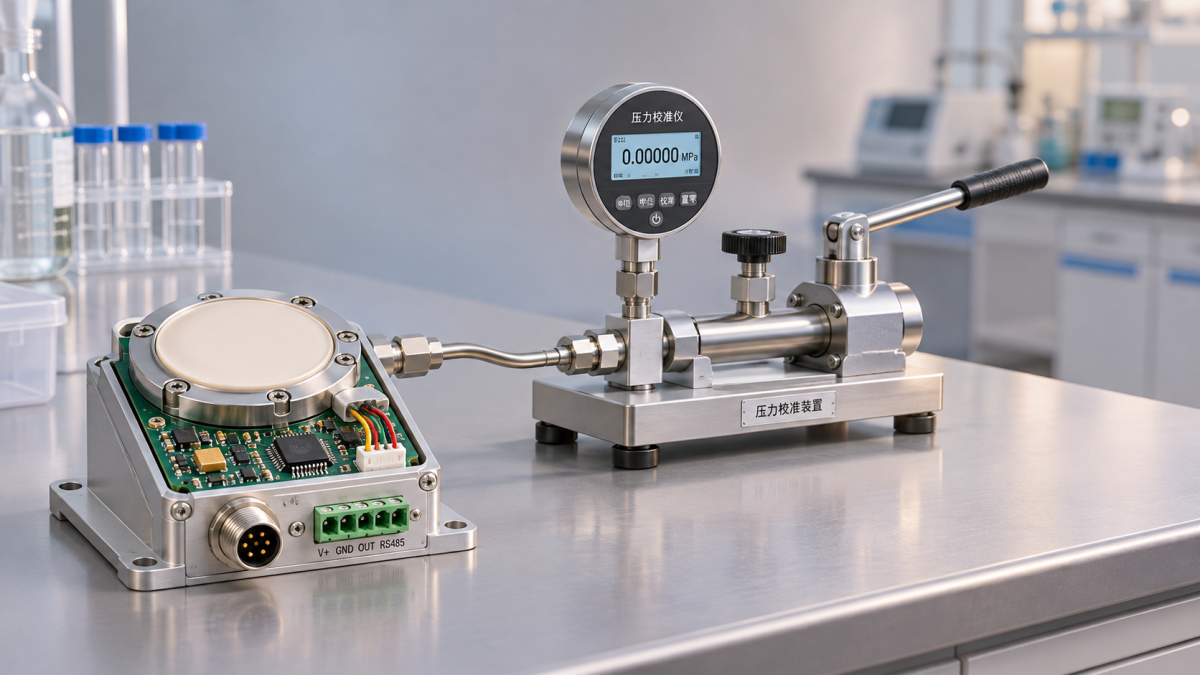
Signal output and integration also influence price. Compare the required supply voltage, output format, electrical connection, response time, and available diagnostic functions. A basic output may be inexpensive to purchase but require additional circuitry and engineering. Conversely, integrated conditioning has value only if it meets the receiving system’s requirements.
Dimensions and mounting are another common source of customization. A buyer evaluating a compact design might review a product listing such as Ceramic pressure sensor diameter 13.5 3.5, then request a drawing and confirm the dimensions, tolerances, pressure connection, and electrical interface before treating it as a fit. A product title alone does not establish interchangeability or performance.
How production volume and customization change the quote
Volume affects the distribution of setup, procurement, calibration, and administrative costs across the order. A supplier may offer a lower unit price for larger quantities, but the buyer must account for inventory carrying costs, demand uncertainty, and the risk of holding parts tied to an obsolete design.
Request price breaks at realistic quantities and distinguish the initial order from the forecast annual volume. A forecast is not necessarily a purchase commitment. Confirm minimum order quantities, release schedules, lead times, and whether the quoted price depends on buying the full volume within a defined period.
Customization can involve a modified pressure port, connector, output, calibration range, or mechanical envelope. Ask suppliers to separate one-time engineering and tooling charges from recurring unit costs. Establish who owns tooling and design documentation, what changes require approval, and whether the custom part creates dependence on a single source.
A standard module is often the lower-risk starting point when its interface and performance meet the application. Customization earns its cost when it removes a measurable integration problem or delivers a required function, rather than merely reproducing an existing design preference.
Testing and quality documentation: compare what is actually delivered
Two modules with the same nominal specification may have different inspection coverage. One quotation may include a final functional check; another may include individual calibration records or environmental testing. These activities consume time and equipment capacity, so their scope belongs in the commercial comparison.
Define acceptance criteria before ordering. Identify the characteristics to be checked, the test conditions, the sampling or individual inspection method, and the records required with each shipment. If traceability is needed, specify whether it must extend to each unit, production lot, raw material, or calibration equipment.
Supplier descriptions can provide a starting point for due diligence. Sansen, for example, describes a quality process that includes supplier audits, raw material traceability, environmental stress testing, and pre-shipment performance verification. A buyer should still establish which checks and records apply to the specific quoted module and purchase agreement.
Do not pay for documentation simply because it sounds comprehensive. Choose evidence that supports your acceptance process, customer obligations, and risk profile. Where a certification or regulatory requirement applies, name the applicable requirement in the quotation request and ask for current evidence covering the supplied configuration; do not assume that a supplier-level claim applies automatically to every product.
Compare Ceramic pressure module quotations on equal terms
The table below separates common cost drivers from the questions that reveal whether a price difference is justified. Use it alongside the supplier’s drawing, specification, and commercial offer.
When an offer falls below the others, investigate the reason before treating it as a saving. It may reflect a standard design and efficient production, or it may omit a required test, connector, temperature condition, or service obligation. Ask suppliers to identify exceptions to the specification explicitly.
Calculate total ownership cost before selecting a supplier
The landed unit price is only the starting point. For an internal comparison, estimate the expected cost over the planned production period using the same demand and service assumptions for every offer:
- Acquisition: unit price, tooling, engineering charges, freight, duties where applicable, and required inspection or certification fees.
- Integration: mechanical adaptation, electronics, software, calibration equipment, and engineering validation.
- Production: incoming inspection, assembly time, yield loss, inventory, and handling of nonconforming parts.
- Service: recalibration, replacement parts, field labor, downtime exposure, and warranty administration.
- Supply continuity: qualification of an alternative source, safety stock, change management, and potential redesign.
Use documented internal costs where available. Where failure rates or service intervals are uncertain, compare scenarios rather than presenting an estimate as a known fact. For example, calculate how much additional field service a lower-priced module would need to cause before its initial saving disappears. This makes the trade-off visible without inventing reliability data.
Lead time also has a cost, but quoted lead time is not the whole story. Ask about capacity, critical components, historical delivery performance where available, and the process for notifying customers of material or process changes. A stable supply arrangement may justify a higher price when interruption would stop production.
Build an RFQ that suppliers can price accurately
A well-prepared request for quotation reduces clarification cycles and makes differences between bids easier to resolve. Involve engineering and quality colleagues before release, especially when the purchasing team inherits a specification from an older design.
- Describe the application. State the medium, pressure reference and range, expected transients, operating temperature, and installation environment.
- Define measurable performance. Specify accuracy and its test conditions, output requirements, response needs, and any stability or cycle-life requirement supported by the application.
- Provide the interface. Supply drawings or controlled dimensions, mounting details, wetted material requirements, electrical connection, and available power.
- Set acceptance requirements. Identify required tests, calibration records, traceability, applicable compliance evidence, and the procedure for handling nonconforming parts.
- State the commercial scenario. Give prototype and production quantities, forecast demand, delivery location, requested schedule, packaging needs, and desired quotation validity.
- Request a cost breakdown. Separate unit price, one-time charges, optional tests, tooling, freight assumptions, minimum orders, and price breaks. Ask suppliers to list all exceptions.
Once bids arrive, review technical exceptions before negotiating the final commercial terms. Where practical, evaluate samples against the agreed acceptance criteria and verify integration in the intended assembly. A sample approval should be tied to a defined configuration and followed by an agreed process for managing production changes.
The strongest purchasing decision is the one that can be defended after installation: the module meets the real operating conditions, the supplier can demonstrate the agreed quality controls, and the commercial offer accounts for the work required on both sides. Use those conditions to shortlist suppliers, then negotiate against a shared specification and a realistic forecast.
Product Categories
Contact Us
Send us a message
First class quality service and professional after-sales team.

Get in Touch
*We respect your confidentiality and all information are protected.
By clicking 'Allow All', you agree to the storage of cookies on your device to enhance site navigation, analyze site usage and assist with our marketing efforts.